Scotland by Campervan: The Ultimate 2-Week Summer Road Trip Guide
🏴 Few destinations on earth combine ancient history, jaw-dropping scenery and genuine driving adventure quite like Scotland in summer. Long golden evenings. Lochs the colour of pewter. Single-track roads with passing places where you pull over for a Highland cow that has zero intention of moving.
This isn't a destination you rush. Two weeks is the minimum to do Scotland justice — and it's the perfect amount of time to thread together the country's most spectacular regions without feeling like you're ticking boxes.
Here's how to approach a 2-week Scotland campervan road trip — and what you need to know before you book.
🗓️ Is Two Weeks Too Long?
Not even close. Scotland rewards slow travel. The country is smaller than it looks on a map, but the roads are narrower and windier than anything most visitors expect — especially if you're coming from Australia, New Zealand or the US. What looks like a 2-hour drive can easily take 3.5 hours in a campervan on single-track Highland roads. Add in a spontaneous stop at a ruined castle, a detour to a sea loch, or an hour waiting for sheep to relocate themselves, and you'll be grateful for every day you have.Two weeks gives you roughly 3–4 days per major region, which is the right pace to actually experience Scotland rather than merely photograph it through a windscreen. Check out the Visit Scotland official tourist information site.

☀️ Scotland in Summer: What to Actually Expect
Summer (June–August) is the best time to visit Scotland for road trippers — but it helps to arrive with honest expectations. This is not Mediterranean summer. It is, however, one of the most spectacular versions of summer on the planet.
| Month | Avg High (°C) | Avg Low (°C) | Rainfall (mm) | Daylight Hours |
| June | 17–19°C | 10–11°C | 55–70mm | 17–18 hrs |
| July | 18–20°C | 11–12°C | 60–85mm | 16–17 hrs |
| August | 18–20°C | 11–12°C | 70–90mm | 14–15 hrs |
The good news: You get 16–18 hours of usable daylight in June and July. In the far north around midsummer, it barely gets dark at all — that extended twilight is genuinely magical for photography and for squeezing in a late hike after dinner.
The honest bit: Scotland doesn't really have a dry season. Rain is possible on any day. The west coast (where most of the drama is) receives significantly more rainfall than the east. Dress in layers, keep waterproofs accessible, and embrace the moody atmospheric light — it's what makes Highland photography so extraordinary.
| ☁️ Packing rule: Scotland weather can deliver all four seasons in a single day — particularly in the Highlands. Lightweight waterproofs, warm mid-layers and good walking boots are non-negotiable, even in July. |
🗺️ The 2-Week Route: Regions to Move Through
This isn't a day-by-day itinerary — that's coming in a linked guide. Think of this as a routing framework: the regions you want to move through, the roads that connect them, and how to pace it sensibly. All pick-up and drop-off from Edinburgh.📍 Region 1: Edinburgh Out — Through the Borders & into Perthshire (Days 1–2)
Resist the temptation to head straight north. The drive north from Edinburgh through the Scottish Borders via the A68 or A7 sets the tone beautifully — rolling farmland, ruined abbeys at Melrose and Jedburgh, and surprisingly little traffic. It's a gentle ease-in that won't throw you into single-track roads on Day 1.
From there, angle northwest through Perthshire — one of Scotland's most underrated regions. The A9 is the main artery north, but the real rewards are on the smaller roads through Dunkeld, Pitlochry and the River Tay valley. Perthshire is where Scotland starts to look properly Scottish: big hills, autumn colours (spectacular even in late summer), whisky distilleries and ancient forest.
- Road note: A9 north from Perth is fast dual carriageway — enjoy it, it doesn't last.
- Dunkeld to Pitlochry on the B8079 is a lovely, manageable alternative to the A9.
📍 Region 2: The Cairngorms (Days 3–4)
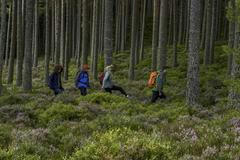
The Cairngorms National Park is the UK's largest — a high plateau of ancient Caledonian pine forest, moorland and some of Scotland's most dramatic mountain scenery. It's ski country in winter (Aviemore, Cairngorm Mountain), but in summer it transforms into hiking, osprey-spotting and distillery territory.
The A9 cuts through the heart of it, but the B970 along the River Spey offers one of the most scenic drives in the park. Whisky trail opportunity: the Speyside region here is home to Glenfiddich, Glenlivet and dozens more.
- Altitude note: The Cairngorms plateau sits at 1,000m+ — even in August, temperatures can drop sharply if you head into the hills.

📍 Region 3: Inverness & the Black Isle (Day 5)
Inverness is the 'capital' of the Highlands and your gateway to the NC500. It's worth at least half a day — Inverness Castle, the River Ness, and the surrounding area around the Black Isle (actually a peninsula) offer a gentle bridge between the Cairngorms and the drama to come.
Loch Ness is just south — and worth seeing even if you're Nessie-agnostic. The A82 along the western shore is one of the most scenic loch-side drives in Scotland.
📍 Region 4: The North Coast 500 — East Route Up (Days 6–8)
The NC500 is Scotland's answer to Route 66: a 516-mile circular route around the northern Highlands starting and ending in Inverness. Most experienced drivers recommend going anti-clockwise — east coast first — saving the more dramatic west coast for when you're comfortable with the roads.
The east coast section runs through Caithness and Sutherland: Dunrobin Castle (a fairytale French château on the coast), the sea stacks at Duncansby Head, John O'Groats (obligatory, even if overrated), and the wild, flat-topped landscape around Caithness that feels like the end of the world in the best possible way.
- Pace note: Allow 3 full days minimum for the complete NC500. Doing it in less means driving past things, which defeats the point.
- Booking: Book campsites on the NC500 in advance for summer — popular sites fill months ahead.

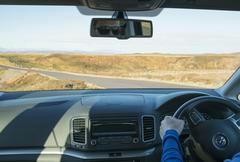
Driving the North Coast 500 on the coastal road to Applecross, Wester Ross
📍 Region 5: The NC500 — North & West Coast (Days 9–11)
This is where it gets extraordinary. The north coast — Durness, Smoo Cave, the vast empty beaches at Balnakeil — feels genuinely remote. Then the west coast descends through Sutherland and Wester Ross: Assynt's lunar landscape of isolated mountains (Suilven, Quinag, Stac Pollaidh), the fishing villages of Lochinver and Ullapool, and eventually Torridon — widely considered among the most dramatic landscapes in Europe.
Applecross and the Bealach na Bà pass deserve their own sentence: it's a single-track road with hairpin bends climbing to 626m above sea level, with views over to Skye. It is genuinely one of the greatest drives on the continent — and one where vehicle size matters enormously (more on this below).
- The B869 Drumbeg loop near Lochinver is also spectacular but not suitable for larger motorhomes — the A837 is the alternative.
- Ullapool is the best-serviced town on the west coast — stock up, eat well, stay a night.
📍 Region 6: Isle of Skye (Days 12–13)
No Scotland road trip is complete without Skye. Cross the Skye Bridge from Kyle of Lochalsh (free, no toll) and you're into another world: black Cuillin peaks, the Old Man of Storr, the Quiraing, Fairy Pools and the sheer weirdness of the Trotternish Peninsula. Skye is exceptional and extremely busy in summer — it's worth at least two nights.
The roads on Skye are predominantly single-track. A smaller campervan is much more enjoyable here than a large motorhome. Parking at major sites like the Fairy Pools fills by 9am in July.
- Portree is the main town — charming harbour, great seafood, book dinner in advance.
- Anti-clockwise around Trotternish (Quiraing first, then Storr) gives you the best light for morning photography.
📍 Region 7: Return South — Glencoe & Loch Lomond (Day 14)
The drive south from Skye through Glencoe on the A82 is one of the most dramatic road journeys in Scotland — dramatic mountain walls, the Devil's Staircase, and a valley so associated with Highland mythology it feels cinematic. Allow a morning here rather than driving through.
From Glencoe, Loch Lomond and the Trossachs National Park sits just north of Glasgow — beautiful, accessible and a lovely final night before returning to Edinburgh the next morning.
| 📍 Edinburgh Note: We're deliberately not building Edinburgh into this route — it deserves its own guide. A separate blog covering how to incorporate Edinburgh at the start or end of a Scotland road trip is coming soon. |
🚐 Choosing the Right Vehicle for Scotland
This is the question we get asked most often — and the one where getting it wrong genuinely affects your trip. Scotland's roads are fundamentally different from what most visitors are used to.What makes Scottish roads different
- Single-track roads with passing places cover huge stretches of the Highlands and virtually all of the NC500's most spectacular sections.
- Passing places are short pull-outs — you need to be able to reverse several hundred metres on a narrow road if you meet oncoming traffic. If you can't do this confidently, you cannot safely drive these roads.
- There are no road rules about vehicle size on most Highland roads — but several specific passes (Bealach na Bà, B869 Drumbeg) are actively signposted as unsuitable for large vehicles.
- Parking at popular sites is tight. A smaller van means access to spots a larger motorhome simply can't reach.
| Vehicle Type | Length | Scotland Suitability | Best For |
| Campervan - McRent Urban plus or Apollo Duo | ~4.5–5.5m | ✅ Ideal – goes everywhere | Couples, all routes incl. NC500 |
| Compact Motorhome (e.g. McRent Compact Plus/Apollo Duo Plus) | ~5.5–6.5m | ✅ Good – minor care needed | Couples/small families, most routes |
| Mid Motorhome (e.g. McRent Family Plus, Bunk Grande) | ~6.5–7.5m | ⚠️ Manageable – avoid 2–3 specific roads | Families; skip Bealach na Bà & B869 |
| Large Motorhome (e.g. McRent Comfort Luxury 7.5m+) | ~7.5m+ | ⚠️ Use with caution | Use alternative NC500 routes only |
| Australian/NZ 'Big' Motorhome (7.5–9m+) | 7.5–9m+ | ❌ Not recommended | Scotland roads not designed for these |
| US Class A / C RV (9–12m) | 9–12m | ❌ Unsuitable | Not appropriate for Scottish roads |

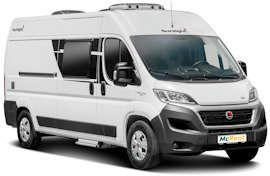

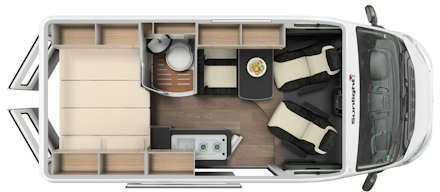
The McRent Urban Plus Camper is the ideal vehicle for a couple
The honest verdict: For Scotland, smaller genuinely is better. The freedom a compact campervan gives you — to turn down a track, squeeze into a village car park, tackle the Bealach na Bà without white knuckles — is worth more than the extra bed space of a large motorhome. You'll have more fun, access more places, and spend less time stressed about passing places.
Our Fleet for Scotland
All four of our Scottish partners — McRent, Bunk Campers, Just Go and Apollo (there are some changes afoot with the supplier, name changes etc, but the DriveNow site will always have the up to-date information) — have vehicles well-suited to this trip. Here's the shortcut guide:
- Best for couples (and the Bealach na Bà): Bunk Campers Aero / Vista, McRent Urban Plus or Compact Plus, Apollo Duo / Duo Plus / Explorer — all compact, highly maneuverable van-based campervans.
- Best for families (with sensible route adjustments): McRent Family Plus, Apollo Traveller, Bunk Campers Grande — capable mid-size motorhomes. Avoid the Bealach na Bà and B869; take the signposted alternatives instead.
- McRent also offers larger Comfort Luxury A-class models — these are genuinely impressive vehicles and work well for the more accessible parts of Scotland, but they're not the right choice for the full NC500 experience.
| ⚠️ Vehicle size reality check: Australian, New Zealand and US travellers are used to much larger hire vehicles. A 9–12m Class A RV or a full-size NZ motorhome is not appropriate for Scotland's Highland roads. Campervans and compact motorhomes under 6.5m give you the best experience. Trust us on this one. |
🦟 One More Thing: The Midges
Scotland's west coast and Highlands are home to midges — tiny biting insects that emerge in calm, damp conditions, typically around dawn and dusk from May to September. They're more annoying than dangerous but can genuinely affect outdoor comfort at campsites if you're not prepared.- Smidge or Avon Skin So Soft are the recommended repellents, Or bring some tropical strength repellent with you.
- A light breeze and midges disappear. Campsite choice matters — coastal sites with sea breezes are far better than sheltered inland spots.
- The Midge Forecast is a real thing:
| 🌐 Plan Your Trip: Search campervans and motorhomes for Scotland on DriveNow — filter by berth size and pick-up location in Edinburgh. All four brands (McRent, Bunk Campers, Just Go and Apollo) have Edinburgh airport depots, making arrival and departure straightforward. |
Image Credits: Visit Scotland